

How Much Does It Cost to Clear Land in Georgia?
How Much Does It Cost to Clear Land in Georgia? 2026 Prices by Region
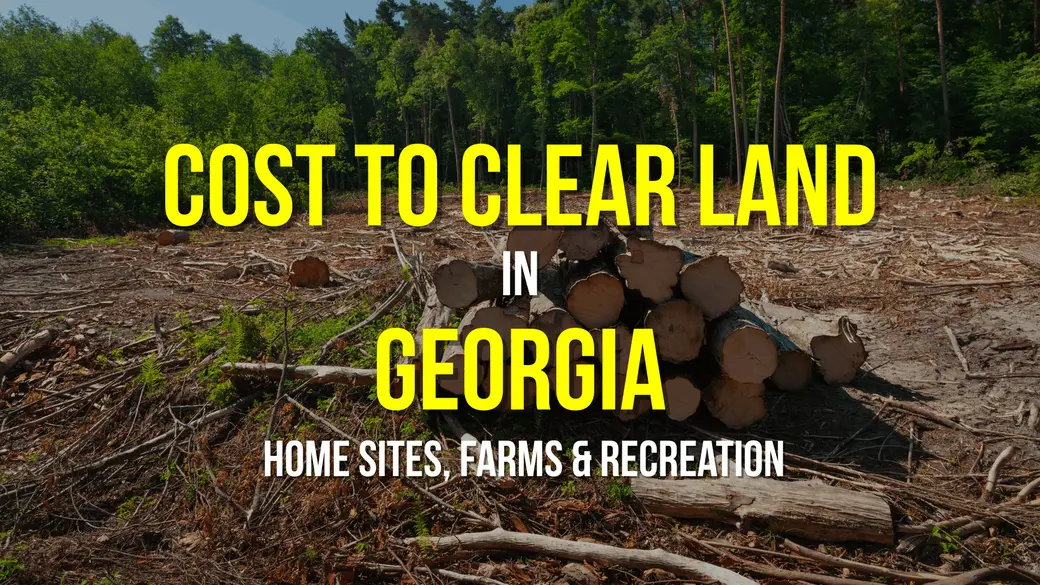
Clearing land in Georgia costs roughly $1,400 to $4,800 per acre in 2026, with most residential and small-acreage projects landing near $3,000 to $3,500 per acre. Light brush on old pasture can come in under $1,000 an acre. Dense mature hardwood on a slope, with stumps pulled and debris hauled off, can run past $10,000 an acre. Where your tract falls depends on four things: how thick the trees are, how steep the ground is, whether the stumps have to come out, and what part of the state you are in.
That last one matters more than most buyers expect. The same five acres costs meaningfully different money in Cherokee County than it does in Lowndes County, and it is not because contractors in one place are greedier.
What does it cost to clear an acre of land in Georgia?
Statewide, expect $1,400 to $4,800 per acre for typical work, with an average around $3,200. That number covers the middle of the market. Light clearing of previously maintained ground runs well below it, and heavy timber removal with full stump extraction runs well above it. Georgia land clearing is priced by the job, not by a rate card, so the range is wide on purpose.
The three tiers most contractors quote:
- Light clearing (brush, saplings, overgrown pasture, light undergrowth): a few hundred dollars to about $1,500 per acre. Common on land that was farmed or grazed within the last decade or two.
- Moderate clearing (mixed brush and medium trees, partial stump work, debris ground or burned on site): roughly $1,800 to $4,000 per acre. This is the most common scenario on Georgia rural land, especially tracts that grew back naturally after timber was cut.
- Heavy clearing (mature pine or hardwood, large stumps, root extraction, full haul-off): $4,500 to $15,000 per acre depending on site conditions.
One caution on all three: the only number that means anything is a written quote from a contractor who has walked the property. Everything above is for budgeting a purchase, not for signing a contract.
How do land clearing costs vary across Georgia?
Georgia is not one market. The state runs from mountain slope in the north to flat coastal plain in the south, and clearing costs follow the terrain and the local disposal options.
Metro Atlanta and the northern suburbs
Metro Atlanta land clearing tends to sit at the upper end of the statewide range. Two reasons. First, you cannot burn land-clearing debris in the 19-county metro nonattainment area, which means debris gets hauled or ground rather than piled and lit. Hauling costs real money per load. Second, lots are smaller and access is tighter, so contractors lose efficiency they would gain on a 40-acre tract.
Counties in this group include Fulton, Cobb, Gwinnett, DeKalb, Cherokee, Forsyth, Henry, Coweta, Fayette, Douglas, Paulding, and Spalding. If you are clearing in Griffin or anywhere else in Spalding County, plan your debris strategy up front, because burning is off the table for part of the year and restricted the rest of it.
Middle Georgia and the Piedmont
Macon, Griffin, Barnesville, Thomaston, Forsyth, and the counties around them sit on red clay. Clay is the defining cost factor here. Wet clay ruts badly under heavy equipment, which means winter and early spring clearing can add grading work on the back end that a dry-season job would not need. Contractors who schedule Piedmont clay work in the dry window often cut total project hours noticeably.
Middle Georgia pricing generally tracks the statewide average, roughly $2,500 to $4,500 per acre for moderate work, with the wet-season penalty being the main variable.
South Georgia
Valdosta, Tifton, Albany, Douglas, and the coastal plain generally clear cheaper. The ground is flatter, the soil is sandier and drains better, the equipment moves faster, and there is an active pulpwood and sawtimber market nearby that gives the trees somewhere to go. On planted pine tracts in particular, south Georgia clearing can come in well under the state average.
North Georgia mountains
Slope and rock are what you pay for up here. Tracts in the Blue Ridge counties frequently need specialized equipment, more erosion control, and sometimes rock breaking. Expect the top of the range or above it, and expect the erosion control plan to be a real line item rather than an afterthought.
If you are still shopping and want to compare tracts before you commit to a clearing budget, you can browse current Georgia land listings here.
Forestry mulching or dozer clearing: which is cheaper in Georgia?
This is the biggest single decision on most Georgia tracts, and the sticker prices are misleading.
Forestry mulching runs roughly $1,800 to $4,000 per acre in Georgia, with most residential projects between $2,500 and $4,500. A mulcher grinds trees, brush, and surface material in place and leaves a mulch layer behind. Nothing gets hauled. On Piedmont clay slopes that mulch layer also holds soil in place while grass establishes, which quietly saves money on erosion control.
Dozer clearing and grubbing looks cheaper on the quote, often $400 to $800 per acre for the push itself. But that number rarely stands alone. Add the stacking crew, the haul trucks, the dump fees, the stump grinder that comes back afterward, and the regrading needed because the dozer stripped topsoil, and the finished cost usually lands above the mulching number.
The honest rule: if you need bare dirt for a house pad, a septic field, or a pasture you will run a tractor over, you need a dozer at some point. If you need the property opened up, thinned, or made usable without a slab going on it, mulching almost always wins on total cost. Many Georgia projects use both, mulching the bulk of the acreage and dozing only the building envelope.
What drives the price up on a Georgia tract?
- Tree density and species. Mature hardwood costs more than planted pine. Georgia hardwoods put down deep root systems that take real equipment time to extract.
- Slope. Anything steep enough to need a tracked machine instead of a wheeled one adds cost, and steep ground triggers more erosion control.
- Stump removal. Grinding is cheaper than extraction. Full extraction is required if you are putting a foundation or a septic field over it.
- Debris disposal. Burning is the cheapest option where it is allowed. Chipping is next. Hauling to a landfill is the most expensive, and in metro Atlanta it is often the only option.
- Access. Narrow county road frontage, no existing drive, wet crossings, or utility easements all slow equipment down and get billed accordingly.
- Season. Clay-heavy Georgia sites clear faster and cheaper in a dry window.
Do you need a permit to clear land in Georgia?
In most cases, yes, once you cross an acre. Under the Georgia Erosion and Sedimentation Act, land-disturbing activity of one acre or more generally requires a Land Disturbance Permit from the local issuing authority, which is usually your county or city. Clearing, grading, excavating, and filling all count as land disturbance. The application has to include an approved erosion and sedimentation control plan.
There are meaningful exemptions. Construction of a single-family residence disturbing less than one acre and not part of a larger development is generally exempt, as are agricultural operations and recognized forestry land management practices. That forestry exemption is why a legitimate timber harvest is treated differently from a clearing job, and it is worth understanding before you decide how to sequence the work.
Rules and fees are set locally, so Pike County, Spalding County, and Lamar County will each have their own process even though the state law is the same. Call the county before you schedule equipment, not after.
Can you burn land clearing debris in Georgia?
Sometimes, and not in the summer in much of the state. Georgia EPD runs an annual summer open burning ban from May 1 through September 30 covering 54 counties across north and central Georgia, including all of metro Atlanta. Yard and land-clearing debris burning is prohibited in those counties during that window because of ozone season air quality.
Outside the ban window and outside those counties, burning land-clearing debris requires a permit from the Georgia Forestry Commission. Hand-piled natural vegetation no longer requires GFC notification under current law, but a machine-piled land-clearing burn is a different activity and does require the permit.
The practical effect on your budget: if your tract is in a banned county and you are clearing in June, price the job with haul-off or grinding, not burning. That difference alone can move a quote by a thousand dollars an acre or more.
Can timber value offset your clearing cost in Georgia?
Sometimes, though 2026 is a weaker year for it than recent memory. Georgia stumpage prices as of late 2025 ran roughly $28 per ton for pine sawtimber in south Georgia and $22 per ton in north Georgia. Pine pulpwood is the soft spot, falling to around $9.50 per ton in south Georgia, down about 40 percent year over year, and pulpwood is projected to stay weak through 2026 without new mill capacity.
What that means in practice: a tract with genuinely mature sawtimber pine can still generate revenue that meaningfully offsets clearing. A tract full of small-diameter pulpwood-grade trees probably cannot, and the logging cost may exceed what the wood brings. Distance to the nearest mill matters too, which is another reason south Georgia tracts pencil out better than north Georgia ones.
A consulting forester, not the logger buying your wood, is the right person to tell you which situation you are in. That review typically costs a fraction of what you would leave on the table by guessing.
How much land do you actually need to clear for a homesite?
Less than most buyers assume. A house, a driveway, a septic field, and a reasonable yard usually fits inside one to two acres. On a 10-acre tract, clearing two acres and leaving eight wooded is both cheaper and, for most rural buyers, more desirable. The woods are why they bought the land.
Before you budget clearing at all, confirm the site will actually support a house. Soil that fails a percolation test can make an otherwise perfect building spot unusable, and clearing it first is money spent on a lot you cannot build on. The sequence that saves money is: perc test, then septic approval, then clearing, then pad prep.
Is it cheaper to buy already-cleared land in Georgia?
Cleared land usually carries a higher price per acre, but it can still cost less to develop. A tract with an existing drive, an open building site, and utilities nearby removes several line items at once. On the other hand, wooded tracts often sell at a discount large enough to fund the clearing and leave money over, especially if the timber has value.
The comparison worth running is total cost to a buildable site, not price per acre. Take the purchase price, add clearing, add the drive, add utility runs, add septic, and compare the finished number across the tracts you are considering. That is the calculation that changes which property is actually the better buy, and it is the one most buyers skip.
More Georgia land buying guides worth reading before you commit:
- How to Buy Land in Georgia
- Well and Septic Approval on Georgia Land
- Cost to Build a House on Your Own Land in Georgia
- Utilities and Infrastructure for Georgia Land Buyers
Frequently Asked Questions About Land Clearing in Georgia
How much does it cost to clear one acre of land in Georgia?
Clearing one acre in Georgia typically costs $1,400 to $4,800, with an average near $3,200 for moderate vegetation. Light brush on old pasture can fall under $1,000 per acre, while heavily wooded acreage with full stump removal and debris haul-off can exceed $10,000 per acre.
How much does land clearing cost in Atlanta?
Land clearing in metro Atlanta generally runs at the higher end of Georgia pricing, commonly $2,500 to $5,000 per acre. Debris cannot be burned in the 19-county metro nonattainment area, so hauling or grinding costs are built into every quote, and tighter lot access reduces equipment efficiency.
How much does land clearing cost in Macon or middle Georgia?
Middle Georgia land clearing generally tracks the statewide average, roughly $2,500 to $4,500 per acre for moderate vegetation. Red clay soil is the main local variable, since clearing wet clay causes rutting and compaction that add grading cost after the job is finished.
How much does land clearing cost in Valdosta or south Georgia?
South Georgia land clearing often comes in below the statewide average because the terrain is flatter, sandy soil supports equipment better, and pulpwood and sawtimber markets are close by. Planted pine tracts in the coastal plain are typically among the cheapest Georgia acreage to clear.
Do you need a permit to clear land in Georgia?
A Land Disturbance Permit is generally required in Georgia for clearing one acre or more, under the Georgia Erosion and Sedimentation Act. Permits are issued locally by the county or city and require an approved erosion and sedimentation control plan. Single-family home construction disturbing under one acre, agricultural operations, and recognized forestry practices are generally exempt.
Can you burn land clearing debris in Georgia?
Burning land-clearing debris is prohibited from May 1 through September 30 in 54 north and central Georgia counties, including all of metro Atlanta, under Georgia EPD's summer open burning ban. Outside that window and those counties, a Georgia Forestry Commission burn permit is required for machine-piled land-clearing burns.
Is forestry mulching cheaper than dozer clearing in Georgia?
Forestry mulching in Georgia costs about $1,800 to $4,000 per acre and usually finishes cheaper overall than dozer clearing, because nothing is hauled off and no stump grinder returns afterward. Dozer clearing quotes look lower at $400 to $800 per acre but exclude stacking, hauling, dump fees, and regrading. Dozer work is still necessary where bare dirt is required for a foundation or septic field.
Can selling timber pay for clearing Georgia land?
Timber sales can offset Georgia clearing costs when a tract holds mature sawtimber, which ran about $22 to $28 per ton in late 2025 depending on region. Pulpwood-grade trees rarely cover the cost, with south Georgia pine pulpwood down near $9.50 per ton and projected to stay weak through 2026. A consulting forester can determine which category a tract falls into.
How long does land clearing take in Georgia?
A one to two acre homesite clearing job in Georgia typically takes a few days. Multi-acre timber removal can take several weeks depending on equipment availability, weather, and how quickly the debris can be processed. Wet weather on Georgia clay soil is the most common cause of delay.
The Bottom Line
Land clearing is usually the first real expense after closing on Georgia acreage, and it is the one buyers most often underestimate. Budget $3,000 to $3,500 an acre for planning purposes, adjust up for slope, hardwood, and metro disposal rules, adjust down for open ground in south Georgia, and get a written quote from someone who has walked the tract before you commit to a number.
If you are comparing tracts and want help thinking through what each one will actually cost to make buildable, start with current Georgia land listings and reach out.
Dekota Oechsle, REALTOR® and Mortgage Loan Originator, NMLS #2811815
Categories
Recent Posts










REALTOR® | Mortgage Loan Originator NMLS #2811815
+1(678) 215-8230 | dekota@movetogriffin.com